












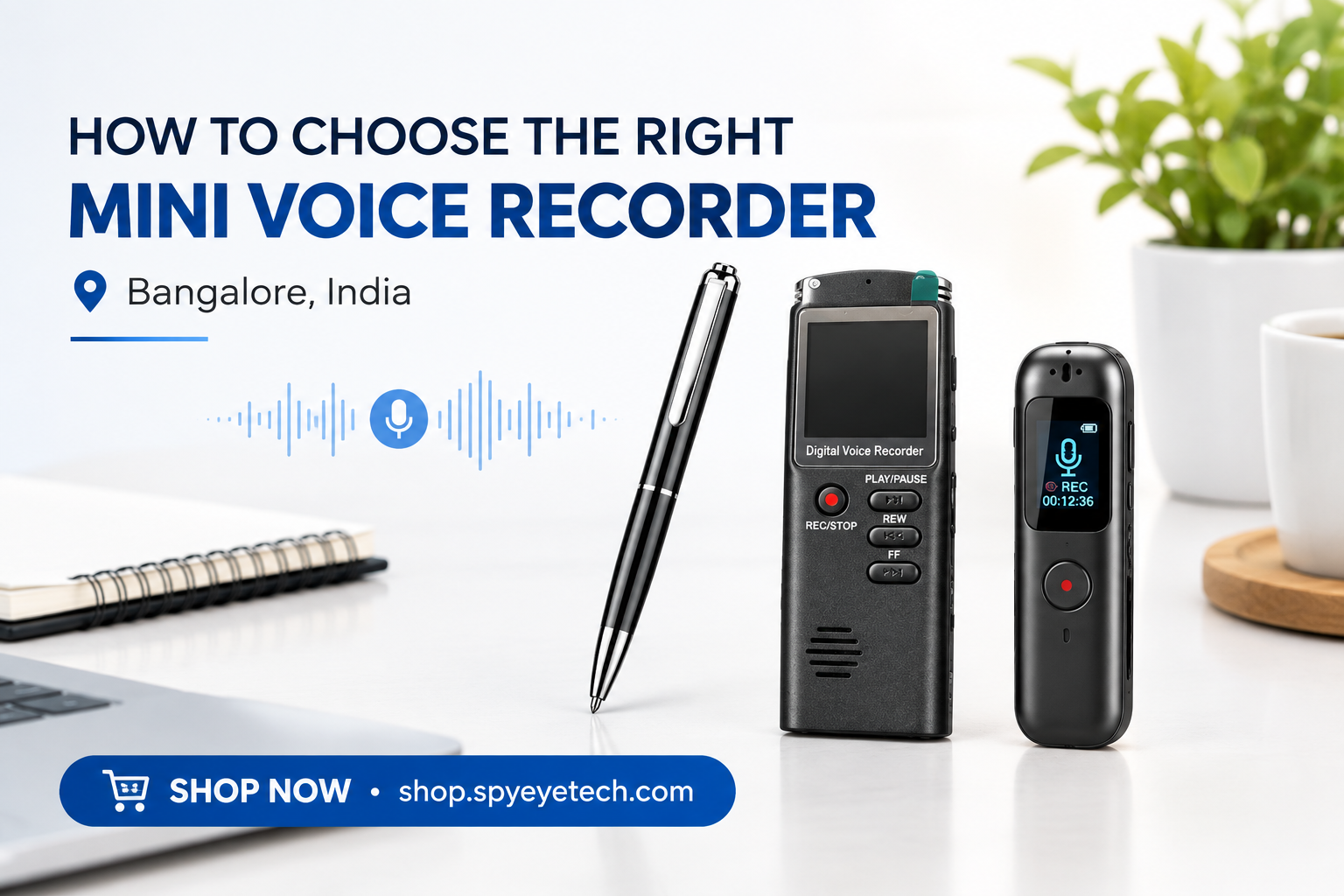
How to Choose the Right Mini Voice Recorder in Bangalore
Finding the right mini voice recorder in Bangalore can be surprising. The variety of pocket-size recorders, digital voice recorders, and mini recorders can fool the buyer into buying a recorder purely on price or size.
But a good mini voice recorder is not simply the smallest recorder you can find. Recording quality, microphones, battery, storage, file format, portability, and many other factors contribute to the choice of a mini voice recorder.
Whether you’re a student looking to record lectures, a professional recording meetings, a journalist recording interviews, or someone who needs a reliable audio note tool, you need to know what to look for in a mini voice recorder.
In this guide we’ll help you choose a mini voice recorder in Bangalore, India and what specifications matter and what do not, and what features to look for while making the purchase.
What Is a Mini Voice Recorder?
A mini voice recorder is a compact digital audio recording device designed to capture voice and sound while remaining easy to carry.
Unlike a smartphone, a dedicated audio recorder is designed specifically for recording. As a result, it can offer convenient physical recording controls, dedicated microphone hardware, local storage, and fewer interruptions from calls and notifications.
Mini recorders are commonly used for:
- Personal voice notes
- Lectures and classes
- Meetings and discussions
- Interviews
- Dictation
- Business notes
- Research and fieldwork
- Audio documentation
- Personal reminders
That said, the ideal recorder depends on how and where you intend to use it.
1. Start With Your Recording Purpose
Before comparing models, first determine what you actually want to record.
This is the most important step because a recorder suitable for short voice notes may not be ideal for a two-hour lecture or professional interview.
For students
If you are recording lectures or study notes, look for:
- Good microphone sensitivity
- Long battery life
- Adequate internal storage
- Simple one-button recording
- Easy USB file transfer
- Noise reduction
For business professionals
For meetings, conferences, and work-related notes, consider:
- Clear speech recording
- Stereo or dual microphones
- Long recording time
- Easy file organisation
- MP3/WAV compatibility
- Reliable battery performance
For interviews
Interviews require better voice clarity. Therefore, microphone quality becomes especially important.
Look for:
- Good voice pickup
- Noise reduction
- Higher-quality recording modes
- Headphone playback
- Easy file transfer
- Sufficient storage
In short, choose the recorder according to the job rather than simply choosing the device with the most features.
2. Check the Microphone Quality
The microphone is arguably the most important component of a voice recorder.
A recorder may have large storage and a powerful battery, but if the microphone produces unclear or noisy audio, those features will not help much.
When comparing a mini voice recorder, check:
- Microphone sensitivity
- Microphone position
- Mono or stereo recording
- Noise reduction
- Voice pickup distance
- Automatic gain control
- Recording quality
For example, if you plan to record a speaker sitting relatively close to the device, a basic microphone may be sufficient. On the other hand, if you are recording a lecture in a larger room, better microphone performance becomes much more important.
Moreover, remember that microphone placement and room noise can affect speech clarity as much as the recorder’s specifications.
3. Look for Noise Reduction
Bangalore is a busy city, and background noise can be a challenge. Traffic, conversations, air conditioners, fans and other environmental sounds can affect recordings.
Therefore, a recorder with digital noise reduction or noise cancellation can be useful.
However, do not rely solely on a product listing that says “noise reduction.”
Instead, if possible, check:
- Real sample recordings
- Customer reviews
- Microphone specifications
- Noise-handling performance
- Recording tests in real environments
A good recorder should produce understandable speech without excessive background hiss or distortion.
4. Consider Battery Life Carefully
Battery life is another major factor.
Imagine attending a three-hour seminar and discovering that your recorder stopped after two hours. Obviously, that defeats the purpose of carrying a dedicated recorder.
Therefore, choose a device with enough recording time for your longest expected session.
As a general rule:
Required battery life = longest recording session + safety margin
For example, if you regularly record 3-hour meetings, choosing a recorder rated for only 3 hours gives you little margin. A model offering substantially longer continuous recording time would be a safer choice.
Also, check whether the advertised figure refers to actual recording time or standby time. These can be very different.
5. Check Storage Capacity
Storage determines how many recordings you can keep before transferring or deleting files.
For occasional voice notes, modest internal storage may be enough. However, students, journalists, researchers and professionals who record frequently should consider higher capacity or expandable storage.
Look for:
- 8GB or more for regular use
- 16GB/32GB for heavier recording
- microSD support where available
- Easy file management
- Standard audio formats
Also, remember that higher-quality recordings consume more storage space. Compressed MP3 files generally take less space, whereas WAV/PCM recordings require considerably more storage.
6. Choose the Right Recording Format
The recording format matters because it affects audio quality, storage requirements, and compatibility.
MP3
MP3 is popular because:
- Files are relatively small
- Easy to share
- Compatible with most devices
- Suitable for everyday voice recordings
WAV / PCM
WAV or PCM is useful when you want higher-quality, less-compressed audio.
It can be suitable for:
- Professional interviews
- Audio editing
- Archiving
- Important recordings
Consequently, if you primarily need simple voice notes, MP3 may be sufficient. If audio quality is more important, consider a recorder that also supports WAV/PCM.
Most importantly, avoid devices that save recordings in unusual proprietary formats unless you know the software required to open them. Standard MP3 and WAV files provide greater flexibility.
7. Consider Voice-Activated Recording
Voice-activated recording, often called VOR (Voice Operated Recording), can be useful when you do not want the recorder continuously capturing silence.
When enabled, the recorder starts or resumes recording when sound reaches a certain level.
This can help:
- Save storage space
- Reduce unnecessary silent sections
- Extend practical recording time
- Make long recordings easier to manage
However, VOR should not be the only feature you evaluate. A poor microphone combined with voice activation will still produce poor recordings. Some VOR systems can also miss the beginning of very quiet speech if the threshold is not suitable.
8. Size and Portability Matter
The main advantage of a mini audio recorder is portability.
A compact device should be:
- Lightweight
- Easy to carry
- Comfortable to operate
- Easy to charge
- Simple to transfer files from
However, there is an important trade-off: making a recorder extremely small can limit microphone size, battery capacity or physical controls.
Therefore, do not automatically assume that the smallest recorder is the best recorder.
Instead, look for a balance between:
Compact size + good microphone + reliable battery + easy operation
9. Check How Easily You Can Transfer Recordings
Recording is only half the job. You also need to access your files afterward.
Before buying, check how recordings are transferred.
Useful options include:
- USB-C
- Built-in USB connector
- USB data cable
- microSD card
- Standard MP3/WAV files
A recorder that makes file transfer complicated can quickly become frustrating, particularly if you record every day.
Consequently, a simple USB connection and standard audio files can save considerable time.
10. Think About Ease of Operation
A mini recorder should not require a complicated process every time you want to record.
For everyday use, look for:
- One-button recording
- Clearly marked buttons
- Easy playback
- Simple volume controls
- Recording indicator
- Easy file deletion
- Quick start recording
Physical buttons can be particularly useful because you can start recording quickly without navigating through multiple menus.
11. Don’t Choose Only by Price
Price is important, but the cheapest recorder is not always the best value.
A very inexpensive model may look attractive because of claims such as:
“Ultra Mini + Huge Storage + HD Recording + Long Battery.”
However, specifications alone do not guarantee real-world performance.
Instead, compare:
| Feature | What to Check |
|---|---|
| Microphone | Sensitivity and voice clarity |
| Recording quality | MP3/WAV and bitrate |
| Battery | Actual recording runtime |
| Storage | Internal memory and microSD support |
| Noise reduction | Real-world effectiveness |
| VOR | Adjustable voice activation |
| Charging | USB/USB-C |
| File transfer | Easy PC/mobile transfer |
| Controls | Simple one-button operation |
| Warranty | Seller/manufacturer support |
As a result, spending slightly more on a reliable recorder can often provide better long-term value.
Where to Buy a Mini Voice Recorder in Bangalore?
If you are looking for a mini voice recorder in Bangalore, you can compare products from local electronics retailers as well as established online stores.
Before purchasing, however, check:
- Product specifications
- Warranty information
- Return/replacement policy
- Customer reviews
- Seller reputation
- Included accessories
- Actual battery rating
- Storage capacity
- Recording format
If buying online, avoid choosing a product solely because it has a very high number of reviews. Instead, read reviews that specifically discuss audio clarity, battery performance, storage and reliability.
Mini Voice Recorder vs Smartphone: Which Is Better?
A smartphone can certainly record audio. Nevertheless, a dedicated mini recorder can be more convenient for regular recording.
| Feature | Mini Voice Recorder | Smartphone |
|---|---|---|
| Portability | Excellent | Excellent |
| Dedicated recording controls | Yes | App dependent |
| Phone call interruptions | No | Possible |
| Notifications | No | Possible |
| Battery sharing | Dedicated battery | Shared with phone |
| Storage | Dedicated | Shared |
| Quick recording | Usually very easy | App required |
| File management | Recording focused | General purpose |
Therefore, if you frequently record lectures, meetings, interviews or voice notes, a dedicated recorder may provide a more convenient workflow.
Quick Buying Checklist
Before purchasing your next mini voice recorder, ask yourself these questions:
☑ What will I mainly record?
☑ How many hours do I normally record?
☑ Do I need noise reduction?
☑ Do I need voice-activated recording?
☑ How much storage do I need?
☑ Do I need MP3, WAV or both?
☑ How will I transfer my recordings?
☑ Is the microphone suitable for my recording distance?
☑ Does the battery last longer than my longest session?
☑ Does the product come with a reliable warranty?
If you can answer these questions, choosing the right recorder becomes much easier.
Frequently Asked Questions
What is the best mini voice recorder for students in Bangalore?
For students, choose a compact recorder with clear voice capture, long battery life, sufficient storage, noise reduction and easy file transfer. A simple one-button recording system is also useful for lectures and classes.
How much storage is enough for a mini voice recorder?
For occasional recording, 8GB can be sufficient. However, if you record lectures, meetings or interviews frequently, consider 16GB, 32GB or expandable storage.
Is a mini voice recorder better than a phone?
For occasional recording, a smartphone can be adequate. However, a dedicated mini recorder can be more convenient for frequent recording because it provides dedicated controls, dedicated storage and fewer phone-related interruptions.
Is noise reduction important?
Yes, particularly if you record in busy environments. However, microphone quality and placement are equally important. Noise reduction should complement good recording hardware rather than replace it.
Should I buy an MP3 or WAV voice recorder?
For everyday voice notes, meetings and lectures, MP3 is usually convenient because the files are smaller. For higher-quality recording and editing, WAV/PCM can be preferable.
What should I check before buying a voice recorder online in India?
Check the microphone, recording format, battery life, storage, noise reduction, file transfer method, warranty, return policy and customer feedback. Most importantly, compare actual recording performance rather than marketing claims alone.
Final Thoughts
Choosing the right mini voice recorder in Bangalore does not have to be complicated.
First, identify your recording purpose. Then, compare the microphone, recording quality, battery life, storage and file formats. After that, consider portability, noise reduction, voice activation and file transfer.
Most importantly, do not buy a recorder simply because it is small or inexpensive. A well-designed compact recorder should provide a practical combination of clear audio, dependable battery performance, sufficient storage and simple operation.
Whether you are a student, professional, interviewer or everyday note-taker, the right small audio recorder can make recording much easier and more reliable.
Choose the features that match your actual needs, compare carefully, and then buy from a trusted seller with clear warranty and support Like SPY EYE TECHNOLOGY.